April 11, 2011

Hosting a Hunter Education Class!

Alderleaf Wilderness College hosted an official Hunter Education Class run by Washington Department of Fish & Wildlife instructors / master hunters - Sharon Rose, Wes Childers, and Ron & Sherry Poppe. It was an excellent class with amazing staff and a great field course. In the photo above, Wes Childers teaches about wildlife identification.


Here students are learning about safe firearm handling, hunting ethics, and sportsmanship. The course also covers wildlife conservation, bow-hunting, rifle & shotgun mechanics, hunting laws and regulations, basic wilderness survival, first aid, and more.


The students had a great time and all passed with flying colors, receiving their Hunter Education Certificates - a requirement for acquiring hunting licenses and tags. We hope to host another class next spring!

A huge thanks goes out to the instructors - Sharon, Wes, Ron, and Sherry - who volunteer their time to teach - thank you thank you!


April 5, 2011

Tracking Wildlife East of the Cascade Mountains

Students and staff from the Wildlife Tracking Apprenticeship traveled east of the Cascade Mountains to track animals in preparation for upcoming tracker evaluations. We visited the foothills on the eastside of the Cascade mountains on our first day.


As we explored the sagebrush steppe, we observed a herd of elk and big horned sheep. We also saw the sign of these animals, including some huge elk antlers that had been shed this springtime. Brandon demonstrates a magnificent pair of antlers in the photo above. Incredible how heavy and large they are!


We also discovered many bones, including skulls, legs and this lower mandible being displayed by tracking apprenticeship student Phil. Such bones and other signs tells the story of the struggles of the animals that lived in this open terrain. The challenges of winter can claim the lives of many animals. But their death is life to many other animals including coyotes, cougars, bears, and a variety of birds and other small animals. Nothing is wasted in the natural world.

The second day, we found our way to the isolated Juniper Dunes. This location has the northern most significant stand of juniper trees. This dune system was deposited by the giant Missoula Floods of the last ice age.


The dunes are home to a variety of creatures, many of which are cryptically colored to blend into their sandy habitat. One such creatures is the pygmy horned lizard (Phrynosoma douglasii).


These little horned lizards are sometimes mistakenly called "horned toads." Though, they are reptiles, not amphibians. Their chunky profiles, and large, rounded heads with wide mouths do look somewhat like a toad.


Some of the insects in the dunes are even more cryptically colored. The grasshopper in this image is practically invisible against the sand, and we only noticed it when it moved!


Another interesting find where several egg cases of a praying mantis (called ootheca). We also found these in the cough pellets of a raven! Seeing this distinct insect sign helped all of us be more prepared for the upcoming Track & Sign Evaluations.

What an amazing way to wrap up our spring studies! The 2 day trip was so packed full of amazing encounters and observations that it felt more like a 4 day trip.

More Alderleaf updates coming soon...!

March 15, 2011

Tracking: the Rabbit and the Fox

On Saturday, the Alderleaf Wildlife Tracking Apprenticeship did a day-long outing to San Juan Island, a unique piece of land in the rain shadow of the Olympic peninsula. This island, once contented over by both the American and British government is home to some unique wildlife. Both European rabbits (Oryctolagus cuniculus) and European red foxes (Vulpes vulpes) where brought to the island to provide sport and food. Though European red foxes were introduced throughout the valleys of the west coast of the USA, the only place European rabbits can be found in the USA is on San Juan Island, in WA state.

Unlike the native Brush rabbits or Mountain cottontails that live in WA state, European rabbits dig burrows and live colonially.


The rabbits are not native to the island, but they do provide food for foxes and eagles.

While tracking recent rabbit activity in a warren, Michelle spotted a silver phase red fox pop out of one of the holes. For a moment they both looked at each other, then the fox ran off over the hill and we ended up trailing it through the dunes.


The foxes trail led us through the prairie and we ended up finding some older fox sign in the process. One of the signs we found from the foxes were these vole nests that had been dug up. In the native prairie throughout the American Camp area, you can observe countless vole runs that ran in many directions under the cover of the grasses.

After exploring the prairie, we checked out the forested area on the hill above. Here we came across some feathers from a recently consumed varied thrush. The forest is home to a variety of birds, including several woodpecker species.


This male hairy woodpecker allowed us to observe its foraging activities from up close. We got to see the freshly made holes where the woodpecker had excavated and consumed some beetle grubs.


Towards the end of our day, we spotted another fox sitting and soaking up the early springtime sunshine. This fox did not run when it saw us, and allowed us to observe its hunting efforts through the grasses and shrubs of the prairie edge.


Here the same fox can be seen flying through air as it pounces as a hidden rodent in the grass. It showed amazing agility and skill as it hunted for its hidden prey.

We felt incredibly lucky to have observed the intimate details of their lives, both through direct observation and through the track and sign they left behind. The day was a tracker's dream, and we left for home inspired and deeply satisfied!


Highlights from Late Feb. and Early March

The Alderleaf Wilderness Certification Program has been very busy over the past few weeks. Students embarked on a variety of educational adventures. Here are some of the highlights from their class days:


Here Alderleaf Wilderness Certification Program student Danny Roaman prepares to fire his primitive hunting tools: a bow and arrow made in class with Frank Sherwood. The theme of this class day was primitive hunting skills, which included the use of rabbitsticks, atlatls and primitive long bows. Danny was practicing firing the bow from a partially concealed position at a moving target.


Here, fellow student Alex Steventon demonstrates the use of an atlatl. This primitive hunting tool was used for hunting everything from deer to mastodons! It is composed of 2 main parts: a throwing dart or arrow and the dart thrower.

One another class day students took a trip to the amazing wildlife park known as Northwest Trek. This location houses only wildlife native to the greater Northwest region. This location provides a unique opportunity for students to closely observe some of the more elusive animals native to the Pacific Northwest, such as bears, cougars and wolves. Through the process of observation, students learned more about how these animals behaved and, therefore, what kind of tracks they left under what circumstances. This opportunity allows the students to grow as both naturalists and wildlife trackers.


Here, a bobcat perches on a fallen tree soaking up the late winter sun. Such relaxed behaviors are very difficult to observe in the wild.

February 21, 2011

Alderleaf Wilderness College Winter Trip 2011


The Alderleaf Wilderness Certification Program spent a wonderful week tracking and working on winter survival skills in the Okanagon region of eastern Washington.

Students got to track a variety of wildlife through the snowy landscape of Ponderosa pine forests, meadows and aspen groves. Some groups traveled through the valley, while others climbed the ridges. Each becoming familiar with the plants and animals of the eastern cascade mountain region. Some of the highlights included: most of the class getting to watch a white long-tailed weasel repeatedly hunting voles through the snow near are main camp, finding tracks of many creatures including pine marten, snowshoe hare, grouse, and cougar, and hearing a chorus of coyotes echoing through the night air.


Students built a variety of snow shelters, including quinzees and snow trench shelters. Such shelters can be surprisingly warm when properly made and are key to surviving the extremely low temperatures of winters. Students constructed them, and slept in them for the week.


Here Alderleaf instructor Dave Scott demonstrates a snow trench shelter, created with an additional wind block wall near the door to help reduce wind chill. The entrance to the shelter can be seen next to Dave's right leg.

The trip was a great success, with many amazing experiences and memories made. The Alderleaf crew left the Okanagon with deep gratitude for all the gifts we received and we look forward to another trip out next winter!

February 1, 2011

December at the Alderleaf Wilderness Certification Program

Just before the Alderleaf Wilderness Certification Program took a break for winter, they were engaged with some naturalists challenges. One of them was a fire making challenging involving small group of students, to see who could pop a balloon full of water first using only flames.


Here students Alex, Dannielle and Ryan work together to feed the fire, while Trevor blows air into the structure to make the flames grow more quickly.


And here is the moment of triumph, when the water in the balloon doses the flames!

Another naturalist challenge involved being led to a tree while blindfolded, then led away and having to find that same tree when the blindfold is removed.


Here student Miles uses his other senses to meet a tree. Later, he successfully found his way back to this same beautiful bigleaf maple tree!

December 14, 2010

Bird Feather ID and Shelter Overnight


Last week, students in the Wilderness Certification Program had the great opportunity to learn from Alderleaf instructor Dave Scott about feathers. They learned about feather structure, function and species identification. As part of the class, we used Dave's new book Bird Feathers: A Guide to North American Species. Feather identification is a skill helpful not only in having a greater appreciation for the natural world, but also is an asset in wilderness survival. Knowing which species are around that might provide a source of potential food is vital in a survival situation.

On the next two days, students built shelters known as "debri-tipis" or "debri-pees" for short. The challenge was to build these shelters from natural materials found at the location, and to sleep in them overnight. That night, the rain fell steadily and the temperatures dropped. In the morning, the students were pleased with what they had accomplished, and how dry and warm they had been!


Here Alderleaf Wilderness Certification Program students Richard and Connor setting up the framework for the roof of their groups debri-pee.


Here fellow students Jackie and Melissa show off their groups' nearly completed shelter. You can see the low doorway near the ground between them.

Advanced Fire Making and much more...

Over the past two weeks, Alderleaf Wilderness Certification Program students have engaged in all kinds of learning adventures. First of all they had a challenging day of advanced fire making, which involved creating bow-drill friction fire kits from wild harvested materials.


Here (from left to right) Danny S., Mellisa L., Georgie L. and Jackie W. team up to get a coal.


Here, Alderleaf instructor Dave Scott demonstrates the use of a challenging friction fire technique called the "fire plow." It requires a lot of pressure and fairly dry conditions, and so are generally preferred in dry parts of the country.

For the next 2 days, the Alderleaf students had their first experience mentoring the youth students at OWLE camp.


Alderleaf Student Miles helps an OWLE camp student create a tule mat.


Here an OWLE student demonstrates a creative use for a pine-needle basket.

November 24, 2010

Snow for Thanksgiving Week!


To the surprise of many, Alderleaf got several inches of snow this week! It turned the property into a white winter wonderland. Here are some images of the property in the snow:


Happy Thanksgiving Day Everyone!

Flintknapping at Alderleaf


Students of the Alderleaf Wilderness Certification Program got an opportunity to learn from experienced survival skills teacher Frank Sherwood recently.

They worked both with raw obsidian as well as glass bottles. Here students Georgie and Connor show their enthusiasm for the craft. They learned techniques such as abrading, pressure flaking, notching and percussion flaking. Then they put them together to create their first flintknapped arrow points.

November 15, 2010

Cedar Baskets with Karen Sherwood

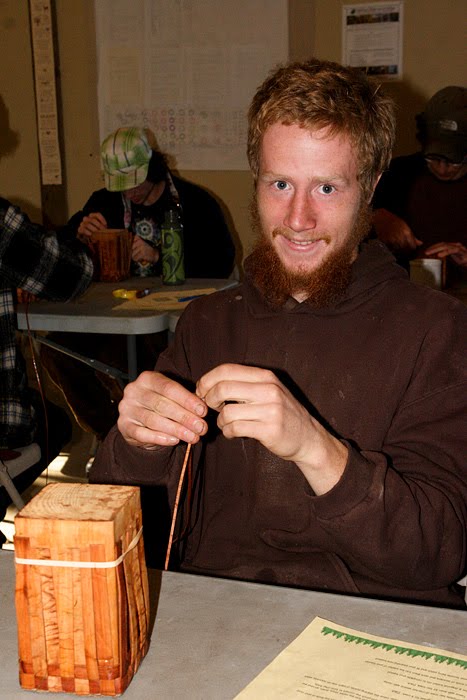
Recently Alderleaf Wilderness Certification Program students experienced using the bark from "the tree of life" (western red cedar) to make beautiful and functional baskets. With Karen Sherwood's instruction and guidance, they got their hands into the task.


Students like Phil J. pictured below, learned to make cedar baskets in the Lummi style.


Baskets have been used by many tribes throughout North America for tasks such as carrying berries, wild game, and even water. These baskets are small containers, traditionally used for gathering berries.

More highlights soon!

Superadobe Root Cellar Nears Completion!

With patience and persistence, many hands came together to make the Superadobe Root Cellar project possible. The project is now very near completion, with the main body of work completed.


Here Danny R., Phil J. and Steve N. celebrate a day of work completed.

Finishing touches will be to back-fill around the root cellar, do some plastering and/or masonry on bags, complete the awning, and depositing soil on top of the structure. Finally the soil will be seeded and the root cellar will be all but invisible, beautifully blended into the landscape.

November 8, 2010

Primitive Water Purification


Water is one of the essential aspects of survival. Knowing how to make it safe to drink is a vital skill. Imagine being in a survival situation without access to more modern means of purifying water... what to do?

Rock boiling water is an excellent way to purify water. If you, however, do not have a container to boil water in you are presented with an additional problem.

Alderleaf Wilderness Certification Program students were faced with this situation on Friday in class. First, they spent some time burning out bowls using coals from a fire.


Then, once it it has been hollowed out enough and scraped smooth, they poured water into it. Next they dropped red-hot golf-ball sized stones into the water to bring it to a boil. The water was allowed to boil for several minutes to allow time to kill water borne parasites. Some western hemlock needles were added for flavor, and allowed to cool.

Students gained a new appreciation for having easily available clean drinking water and learned skills they will have to put to the use on their survival trip at the end of the year.

November 2, 2010

Olympic Peninsula Magic

This past week the Alderleaf Wilderness Certification Program students went on a several day adventure to the Olympic Peninsula. We visited the incredible collection at the Makah Museum in Neah Bay on our first day. Practically all of the artifacts found in the museum came from a site at Cape Alava, where a landslide buried and preserved an entire Native village.

The following day, we explored the boggy cedar forests and wild coastline of the Ozette area. The collection in the museum came from this same area!

Students got the opportunity to get to know the seashore life, and learn more about edible seaweeds and other edible seashore creatures.


The tide pools were rich with a wide assortment of life forms.


One group of students found a freshly dead adult brown pelican. The bird had no obviously apparent external injuries. We wondered if this bird was perhaps a victim of the red tide that was happening out in the ocean.

Though sad, this animal provided close looks at the details of its beautiful plumage and amazing beak. It's 6 foot plus wingspan was also incredible to see!


Deer are incredibly tame along this stretch of coastline as they have not been hunted here for many years. The area is abundant with many kinds of wildlife, including bald eagles, sea lions, sea otters, and many other sea shore creatures.

Our last day on the Olympic Peninsula was ended with a visit to the Hoh Rainforest, home of incredible old-growth forest full of huge and ancient cedars, spruces and Douglas firs. Students were deeply impressed with the magnificence and abundance of this ancient forest.

Our last day came to a close with a blazing sunset over the Olympic mountains, as we headed east back to Seattle.

The trip was absolutely amazing, and blessed with abundant sunshine and great encounters with the natural world. More stories from the Alderleaf Wilderness Certification Program to come soon!

October 26, 2010

Wildlife Trailing with Adriaan Louw of South Africa

Alderleaf hosted Adriaan Louw - professional tracker from South Africa for trailing classes and CyberTracker trailing evaluations last week. (trailing is the tracking skill of following subtle tracks and sign to find an animal). It was an amazing week of trailing elk up in the Cascade Mountains! Here's some footage:


Also - congratulations to those who took the trailing evaluation - trailing certificates were awarded to Phil J (Trailing I), Daniel R (Trailing I), Steve N (Trailing II), Michelle P (Trailing II), and Jason K (Trailing III).

A big thanks to Adriaan for making the time to visit the northwest to share his expertise!

October 12, 2010

Permaculture Training at the Alderleaf Wilderness Certification Program

Here's some video clips of the first week of permaculture training during the 2010-2011 Alderleaf Wilderness Certification Program (taken by student & video intern - Jeff). The class learned about permaculture principles and ethics, design concepts, sector & zones, as well as hands-on training in plant propagation (division, transplanting, layering, cuttings and seed collection) and garden bed preparation (sheet mulching, double-digging, and composting strategies). Thanks for the clips Jeff!

October 6, 2010

Oregon Dunes Adventure

The Alderleaf Wilderness Certification Program Students just returned from their first week-long adventure in the Oregon Dunes!

This trip is an exciting and excellent introduction into wildlife tracking and naturalist studies for the year-long students. Stretching over 50 miles long, the Oregon Dunes are an incredible wildlife hot spot that include forest mazes, wetlands and HUGE dune systems that can sometimes seem other worldly. The meeting of a variety of habitat types makes it very diverse, and the presence of sand makes tracking rich and exciting.


Here students Brandon, Jonny and Chris get down to the serious business of track identification and study. The story told by these little hopping tracks was a truly epic journey by a tiny treefrog across one of the biggest dunes in the whole area. It traveled at least a quarter mile across the open sand to reach a new area. What motivated it to move so far?


Here student Matt shows off one of the mystery plants found along a fresh water wetland edge. After some careful study, he figured out the identity of this lovely little yellow flower: brass buttons (Cotula coronopifolia). A fitting name for this petal-less, golden button of a flower. Its other name, "mud-disk" is also descriptive of its habitat preferences.

Though the students were down to some serious naturalist studies, in such an epic natural setting it is impossible to not connect to the passions of a child.


Overall, an incredible week of beautiful weather, great tracking and amazing animal encounters!

October 5, 2010

First weeks of the Alderleaf Wilderness Certification Program

The first few weeks of the Alderleaf Wilderness Certification Program are underway, and the students have jumped right into their studies with gusto.

Here are some highlights from the last few weeks:


The students got to make their first friction fire kits, using the bow-and-drill method. It was inspiring to see so many students get their first coals and first friction fires of their lives. Here student Dannielle successful gets her first friction fire ever, even with added challenge of 2 bandaged fingers!


On their first day with instructor Allen "Hawkeye" Sande, the students got to jump right into practicing teaching methods through the use of enthusiasm and some story-telling. Here two students, Chris and Brian tell the story of the first Northern flying squirrel.


On another day, students had the great pleasure of being introduced to wild edible plants by Karen Sherwood. What better way to get to know them than through turning them into delicious wild edible meals?!

A great start to the new school year!