November 24, 2010

Snow for Thanksgiving Week!


To the surprise of many, Alderleaf got several inches of snow this week! It turned the property into a white winter wonderland. Here are some images of the property in the snow:


Happy Thanksgiving Day Everyone!

Flintknapping at Alderleaf


Students of the Alderleaf Wilderness Certification Program got an opportunity to learn from experienced survival skills teacher Frank Sherwood recently.

They worked both with raw obsidian as well as glass bottles. Here students Georgie and Connor show their enthusiasm for the craft. They learned techniques such as abrading, pressure flaking, notching and percussion flaking. Then they put them together to create their first flintknapped arrow points.

November 15, 2010

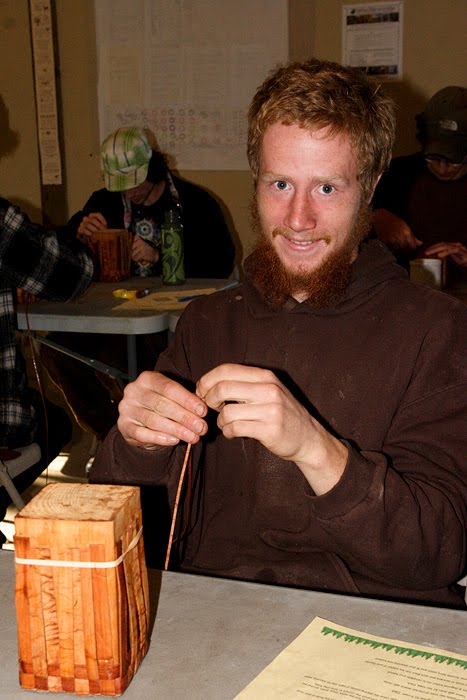
Cedar Baskets with Karen Sherwood

Recently Alderleaf Wilderness Certification Program students experienced using the bark from "the tree of life" (western red cedar) to make beautiful and functional baskets. With Karen Sherwood's instruction and guidance, they got their hands into the task.


Students like Phil J. pictured below, learned to make cedar baskets in the Lummi style.


Baskets have been used by many tribes throughout North America for tasks such as carrying berries, wild game, and even water. These baskets are small containers, traditionally used for gathering berries.

More highlights soon!

Superadobe Root Cellar Nears Completion!

With patience and persistence, many hands came together to make the Superadobe Root Cellar project possible. The project is now very near completion, with the main body of work completed.


Here Danny R., Phil J. and Steve N. celebrate a day of work completed.

Finishing touches will be to back-fill around the root cellar, do some plastering and/or masonry on bags, complete the awning, and depositing soil on top of the structure. Finally the soil will be seeded and the root cellar will be all but invisible, beautifully blended into the landscape.

November 8, 2010

Primitive Water Purification


Water is one of the essential aspects of survival. Knowing how to make it safe to drink is a vital skill. Imagine being in a survival situation without access to more modern means of purifying water... what to do?

Rock boiling water is an excellent way to purify water. If you, however, do not have a container to boil water in you are presented with an additional problem.

Alderleaf Wilderness Certification Program students were faced with this situation on Friday in class. First, they spent some time burning out bowls using coals from a fire.


Then, once it it has been hollowed out enough and scraped smooth, they poured water into it. Next they dropped red-hot golf-ball sized stones into the water to bring it to a boil. The water was allowed to boil for several minutes to allow time to kill water borne parasites. Some western hemlock needles were added for flavor, and allowed to cool.

Students gained a new appreciation for having easily available clean drinking water and learned skills they will have to put to the use on their survival trip at the end of the year.

November 2, 2010

Olympic Peninsula Magic

This past week the Alderleaf Wilderness Certification Program students went on a several day adventure to the Olympic Peninsula. We visited the incredible collection at the Makah Museum in Neah Bay on our first day. Practically all of the artifacts found in the museum came from a site at Cape Alava, where a landslide buried and preserved an entire Native village.

The following day, we explored the boggy cedar forests and wild coastline of the Ozette area. The collection in the museum came from this same area!

Students got the opportunity to get to know the seashore life, and learn more about edible seaweeds and other edible seashore creatures.


The tide pools were rich with a wide assortment of life forms.


One group of students found a freshly dead adult brown pelican. The bird had no obviously apparent external injuries. We wondered if this bird was perhaps a victim of the red tide that was happening out in the ocean.

Though sad, this animal provided close looks at the details of its beautiful plumage and amazing beak. It's 6 foot plus wingspan was also incredible to see!


Deer are incredibly tame along this stretch of coastline as they have not been hunted here for many years. The area is abundant with many kinds of wildlife, including bald eagles, sea lions, sea otters, and many other sea shore creatures.

Our last day on the Olympic Peninsula was ended with a visit to the Hoh Rainforest, home of incredible old-growth forest full of huge and ancient cedars, spruces and Douglas firs. Students were deeply impressed with the magnificence and abundance of this ancient forest.

Our last day came to a close with a blazing sunset over the Olympic mountains, as we headed east back to Seattle.

The trip was absolutely amazing, and blessed with abundant sunshine and great encounters with the natural world. More stories from the Alderleaf Wilderness Certification Program to come soon!

October 26, 2010

Wildlife Trailing with Adriaan Louw of South Africa

Alderleaf hosted Adriaan Louw - professional tracker from South Africa for trailing classes and CyberTracker trailing evaluations last week. (trailing is the tracking skill of following subtle tracks and sign to find an animal). It was an amazing week of trailing elk up in the Cascade Mountains! Here's some footage:


Also - congratulations to those who took the trailing evaluation - trailing certificates were awarded to Phil J (Trailing I), Daniel R (Trailing I), Steve N (Trailing II), Michelle P (Trailing II), and Jason K (Trailing III).

A big thanks to Adriaan for making the time to visit the northwest to share his expertise!

October 12, 2010

Permaculture Training at the Alderleaf Wilderness Certification Program

Here's some video clips of the first week of permaculture training during the 2010-2011 Alderleaf Wilderness Certification Program (taken by student & video intern - Jeff). The class learned about permaculture principles and ethics, design concepts, sector & zones, as well as hands-on training in plant propagation (division, transplanting, layering, cuttings and seed collection) and garden bed preparation (sheet mulching, double-digging, and composting strategies). Thanks for the clips Jeff!

October 6, 2010

Oregon Dunes Adventure

The Alderleaf Wilderness Certification Program Students just returned from their first week-long adventure in the Oregon Dunes!

This trip is an exciting and excellent introduction into wildlife tracking and naturalist studies for the year-long students. Stretching over 50 miles long, the Oregon Dunes are an incredible wildlife hot spot that include forest mazes, wetlands and HUGE dune systems that can sometimes seem other worldly. The meeting of a variety of habitat types makes it very diverse, and the presence of sand makes tracking rich and exciting.


Here students Brandon, Jonny and Chris get down to the serious business of track identification and study. The story told by these little hopping tracks was a truly epic journey by a tiny treefrog across one of the biggest dunes in the whole area. It traveled at least a quarter mile across the open sand to reach a new area. What motivated it to move so far?


Here student Matt shows off one of the mystery plants found along a fresh water wetland edge. After some careful study, he figured out the identity of this lovely little yellow flower: brass buttons (Cotula coronopifolia). A fitting name for this petal-less, golden button of a flower. Its other name, "mud-disk" is also descriptive of its habitat preferences.

Though the students were down to some serious naturalist studies, in such an epic natural setting it is impossible to not connect to the passions of a child.


Overall, an incredible week of beautiful weather, great tracking and amazing animal encounters!

October 5, 2010

First weeks of the Alderleaf Wilderness Certification Program

The first few weeks of the Alderleaf Wilderness Certification Program are underway, and the students have jumped right into their studies with gusto.

Here are some highlights from the last few weeks:


The students got to make their first friction fire kits, using the bow-and-drill method. It was inspiring to see so many students get their first coals and first friction fires of their lives. Here student Dannielle successful gets her first friction fire ever, even with added challenge of 2 bandaged fingers!


On their first day with instructor Allen "Hawkeye" Sande, the students got to jump right into practicing teaching methods through the use of enthusiasm and some story-telling. Here two students, Chris and Brian tell the story of the first Northern flying squirrel.


On another day, students had the great pleasure of being introduced to wild edible plants by Karen Sherwood. What better way to get to know them than through turning them into delicious wild edible meals?!

A great start to the new school year!

The Superadobe Root Cellar is growing!


The Superadobe root cellar is taking shape! With the help of students, residents and staff it grows coil by coil.

For those of you who might not be familiar with Superadobe construction, it is a method of natural building created by Nader Khalili. This approach is a modern form of adobe which utilizes bags of local soil in the form of coils which are stabilized with barbed wire between each layer. This method uses arches, domes, vaults and apses to create structural strength and beauty. Though, this method can be built into the more traditionally modern rectangular structures.


Everyone involved is excited to see this project progress and move towards completion. Upon completion, this wonderful structure will be able to house a variety of edible goods from the Alderleaf farm without the need for refrigeration. It will also be another great example of a natural building utilized on the Alderleaf Campus.

October 4, 2010

Welcome to the 2010-11 Alderleaf Wilderness Certification Program


The Alderleaf Wilderness Certification Program has started a new school year and we are excited to welcome all of the new students.

Say hello to the class of 2010-2011!

Another fun and exciting school year with the Alderleaf Wilderness Certification Program is now underway.

July 29, 2010

Beautiful Bows Created with Peter Yencken!


Alderleaf was honored to host experienced bowyer, Peter Yencken from Australia, for a special bow making weekend workshop this July. Four lucky students had the opportunity to be coached by Peter in building beautiful hickory bows. Everyone came away with great bows, arrows, and practical techniques for intuitive archery. Thanks Peter!

Aquatic Permaculture Plants Added to Ponds

Implementation of permaculture projects is moving along well this summer. We've introduced a variety native and cultivated edible, medicinal, and utilitarian aquatic plants into the new ponds - including wapato, perennial wild rice, aronia, arrowhead, cattail, bulrush, and much more. We've also added a water collection swale and berm to funnel water to oxygenate the pond. Next spring we hope to have enough plant life and oxygen to be able to introduce fish for a complete aquaculture system!

Pictured above is one of our new wapato plants. Wapato has a tasty edible tuber that was a staple food for indigenous people of the northwest. The Japanese have also cultivated a close relative as a food plant. It also provides important wildlife habitat.

Pictured here is a perennial wild rice plant that we added to the new ponds. This plant is native to the western Great Lakes region and the grains can be harvested as an extra tasty and nutritious variety of rice - considered gourmet by many. Native Americans of the midwest harvested it in large quantities from canoes. Permaculturists in North American have been experimenting with cultivating this unique aquatic plant.

Pictured above is the new swale, berm, and pipe - which will help to oxygenate the water once the rains return in the fall (an important need for having fish). A solar pump will be utilized to oxygenate the pond during our summer dry season.

The purpose of the ponds is to provide additional habitat diversity; store water; attract more wildlife; provide more food, medicine, and materials for people; create additional microclimates; and to raise fish to eat. We're also utilizing a small pond to cultivate duckweed and azolla for chicken feed and natural fertilizer in our compost piles. Vibrant ponds and diverse aquaculture systems are often important components to a holistic permaculture approach to sustainability.

July 16, 2010

Ancient Stone Point Discovered at Alderleaf

During a sunny July day, Alderleaf resident Phil Johnston made an exciting discovery on the property. He found an oddly shaped stone, that he soon realized was a stone point. The stone piece is exactly 4 inches long.


This “Cascade Point” was found in McCoy Creek near the eastern edge of the Alderleaf property in July 2010. It is likely from the Olcott Complex, a grouping of stone artifacts found in the Snohomish, Snoqualmie, and Skykomish drainages that date from 4,500 to 9,000 years ago! It is made from basalt, which is a type of igneous rock found here in western Washington. The size of the piece indicates that it was possibly used as an atlatl dart tip.


Take a close look at the straight edge of this stone point. This appears to be the work of a skilled flintknapper. This stone point may have been lost during hunting. It may have even been used several times to provide food for the people who once hunted here, before it was lost!


This incredible find adds a little bit of knowledge and history to the story of Alderleaf and the surrounding lands. Just imagine what it must have been like to be hunting a deer or an elk with a stone-tipped atlatl along the McCoy Creek drainage thousands of years ago!

On a related note, we offer a Stone Tools Workshop at Alderleaf, where we make similar implements including stones knives, arrowheads and more!

July 1, 2010

New Residents at Alderleaf - Milking Sheep!


As part of Alderleaf's permaculture plan (our efforts to become more sustainable and self reliant), we've acquired two milking sheep at Alderleaf Farm! Mom is a Friesian dairy breed and the lamb is a cross with a Black Welsh Mountain breed.

They're exciting animals to have at the farm because they not only provide milk, but also wool for clothing (and felting projects), lots of manure (fertilizer for the gardens) and more lambs. They require less space and resources than larger animals like cows. They also help tend the pasture and lawns (reducing the need to mow), while fertilizing the land!

We feel they're a great addition to the farm and hope you get a chance to meet them the next time you visit!

June 9, 2010

2009-2010 Certification Program Graduation

The Alderleaf Wilderness Certification Program completed its school year and celebrated graduation on Saturday June 5. It was an incredible, practically miraculous, day of sunshine and warmth after nearly a solid month of rain. As if the sun had come to warm everyone during the celebration and send them warmly on their way into the world. We could not have asked for better weather.

Graduation was followed by a huge feast, with a rich assortment of meals and desserts tempting everyone. Many goodbyes were said, hugs given and well-wishes spoken.

Thank you class of 2009-2010! All the staff wishes you the best out there in the world! May you find joy in whatever your doing and maintain your connection to the natural world.

May 3, 2010

Visit to the Bullock's Permaculture Homestead

As the Alderleaf Certification Program moves towards a close, we have completed our final days of Permaculture. To celebrate our year of learning and practicing permaculture ideas and techniques we traveled to one of the oldest running permaculture farm in the country: the Bullock's permaculture homestead.

Our day started with a beautiful ferry ride into the San Juan Islands. The Bullock's homestead is located on Orca's Island, in Deer Harbor. The homestead is in a micro-climate within a micro-climate, being in a sunny part of WA state and on a sunny Southwest facing hillside. This incredible nearly 20 acre property is a shinning example of permaculture in action. It is impossible to capture in words all of the intricate systems, mind-boggling variety of plants of countless shapes, colors, smells and tastes that cover the land in a riot of diversity!

Doug Bullock was our host and tour guide for the day. His many years of experience around the world applying permaculture principles in places such as New Zealand, Hawai'i, Australia, Costa Rica, Nicaragua, California and Washington. His knowledge of plants and ecosystems from these and other areas is awe-inspiring.


Here Doug is pointing out the huge leaves of an edible plant from South America who's stems are chopped up and eaten raw. Plants at the Bullock's homestead grow abundantly, intermixed in to many different guilds. Plant guilds are a grouping of plants grown together for the mutual benefit of all. So that every species in a guild supports the other, making them all more vital, healthy and productive.


Here Doug leads us through one of several greenhouses on the property. Here many of the farms plants are propagated and plant cuttings are rooted to be sold or for planting throughout the property. The amount of food produced on the farm has to be seen to be believed.


Another gem of the Bullock's homestead is this (see photo above) several acre wetland. When the Bullock's purchased the property, the observed that there was an old drainage ditch coming out of a field. They quickly chose to dam the drainage and let the water pool up. In a short time, it turned into a wetland which they helped along with planting a variety of native vegetation. They introduced some fish as well as native amphibians and turtles. The wetland has become a thriving ecosystem, which has been designated a birding hot spot, with over 100 species observed there!

Doug described how even here, humans are part of the land. The needs of both wildlife and humans can be met, and both can thrive. One way that the Bullock's utilize the wetland is using a very old method of forming growing islands, called "chinapas" that were used in southern Mexico by the Aztecs. The technique involves digging up material from the bottom of the wetland, and piling it up with brush and other materials to make small island. Food bearing plants that enjoy moisture are grown on these islands. It also creates foraging and nesting habitat for a wide range of wetland species.

The Bullock's farm was truly an incredible location to experience and one of the finest examples of a working permaculture homestead in the world. It was a treat and an honor to visit. We all look forward to another trip there in the next school year!

April 27, 2010

Fishing Spears, Edible feast and Bird language outing

Last week was a week of celebration and learning. Students of the Alderleaf Certification program spent a day learning how to make and using primitive fishing spears with Frank Sherwood. Our last day with Karen Sherwood was a day of feasting and celebration of all the green growing things. Then our week came to a close with a final bird language class in a exciting birding hotspot.


Matt and Kelley are stoked about making and practicing with the primitive fishing spears! Their grins say it all.


Like a bowl full of sunshine, gathered dandelion flowers await being dipped and cooked up as fritters. Karen inspired everyone to add their own touch to the wild food that was gathered and prepared for eating. The meal included a wild greens salad, a cattail stir-fry, stinging nettle pesto and cattail pollen crapes with elderberry syrup.


A feast for the eyes as well as the taste buds!


Our week came to an exciting close with a trip out to a birding hotspot in Seattle called the Union Bay Natural Area. Despite its relatively small size, this spot has tons of birds and other wildlife. Some people have record over 180 species of birds observed in this area.

One of the many high lights of our day was observing a killdeer defending her nest against predators. When Steve Nicolini and I ventured too close to her nest, she tried to lure us away from it by feigning an injury (as you can see in the photo above). To our surprise, however, when the whole class came close to the nest she did something very different: she stood over the nest and scolded all of us. This makes sense, as with so many humans plodding around there was a good chance someone would step on her eggs!


Some of the other students also had a chance to observe a red-tailed hawk getting mobbed by a crow and a red-winged blackbird, as well as observing a bald eagle catching a gadwall duck. It was possibly one of the most exciting bird watching days of the year!

Track & Sign Evaluations for the Alderleaf Crew

The Alderleaf Wilderness College Certification Program students have been very busy this spring. Two weeks age, they completed taking the Track & Sign evaluations put on by the CyberTracker International organization. These evaluations are meant to assess the ability to recognize and interpret wildlife track and sign. They also provide an incredible opportunity for students to learn more about tracks & sign, and are a great deal of fun to boot!


The test is taking in a variety of locations throughout western Washington state. Here is one such location along the Snoqualmie River. Here students are studying a set of river otter tracks and pondering which foot and which side of the body it is on!


Here is a beautiful set of tracks found by the edge of the water. Who left these little footprints?


We are thankful to have had this opportunity to learn more about tracking! Special thanks to Casey McFarland (our evaluator), to everyone who assisted and to all who participated in the process. It was an amazing experience!

March 29, 2010

March: Tracking Outing to Potholes Dunes

This month the tracking apprenticeship took an exciting day out to track and trail in the Potholes Dunes near Moses Lake. This trip was focused on preparing for the tracking evaluations coming up later this spring.


This area is a wonderfully diverse landscape where there is a mosaic of both desert and wetlands habitats blending. Some of the animals found here are not found on the west, rain side of the mountains. Others are found on both sides of the mountains. The tracks in this photo lead between one patch of wetlands to another. If you look closely, you can even see the webbing between some of the toes. These are the tracks of a large, aquatic member of the weasel family.


Here, Matt and Kyle grin at this hilarious find. A coyote apparently dragged its backside down the hill through the sand, then continued on its merry way off to the left! Guess it had an itch. You never know what you might find when you are out tracking.


Here Kyle closely inspects a trail we discovered at end of our day. We had talked about the mysterious grasshopper mouse earlier in the day, and then came upon this... This trail did not seem to match anything we had seen that day. It was a pretty odd gait for such a small mammal, a lot of walking and trotting. This animal went from cover to cover, then started wandering around in the semi-open as if foraging. Perhaps it was hunting?

Had we seen the elusive grasshopper mouse?

We left with that trail as a mysery, having been satiated on plentiful tracks and sunshine.

As we headed home, the fading light glowed behind Mt. Rainer...


We are all looking forward to another outing with Alderleaf Tracking Apprenticeship!

March 23, 2010

Rock Boiling: Survival Water Purification


Using a rock boiling technique to purify water at our Weekend Wilderness Survival Course.

This is a way to effectively purify water in a survival situation if you did not have a filter system or chemical treatment. The containers are coal-burned bowls made from logs. It is a completely primitive technique that requires no specialized equipment.

The little scrubby made from an evergreen tree branch is used to wipe off ash off of the hot stones. The first bowl of water (not for drinking) is for dunking to get off the remaining ash. Too much ash in water is not good to drink.

The second bowl of water is being boiled. Once the water reaches boiling temperature it is safe to drink. When the water begins to cool we add pine needles to add good flavor and vitamin C.

March 4, 2010

February at the Certification Program

Another jam-packed month at Alderleaf has come and gone. Signs of spring are appearing all over campus. The voices of birds grows louder everyday. Frogs singing in the evenings and buds are popping all over the place. Even the first bumble bees of spring have made an appearance!


The month of February has been an exciting one for the Alderleaf Wilderness Certification Program. We have continued forward on our learning journey and covered a lot of new ground. Students did everything from making cattail mats and soothing cottonwood salves with Karen Sherwood, to practicing making primitive survival traps with Jason Knight.

One day we had guest instructor Dave Scott come in and teach about the amazing world of bird wings and feathers, their functions, and how to identify them using a several teared method.


On another great day students learned about and experienced the practices of habitat restoration and forest stewardship. Native plants were added to the native restoration area at the entrance to the farm. Also, students got to plant between 150 and 200 small Douglas firs and western red cedars as part of the stewardship process in the wooded areas of the property. Thus, encouraging our forests to move towards the complex and diverse structure that mirror the old-growth.


While learning more about primitive living and survival skills, students spent another day learning a variety of methods for water purification. The oldest and one of the simplest forms is through boiling the water to destroy any potential parasites. But first, you have to make a container! There in lies the need to create bowls via burning with coals from the fire. Here Certification Program student Greg Evans demonstrates the technique.


During a 3 day permaculture session with instructor Adam Rawson, students had an opportunity to look at the idea of building from a new perspective: biotecture! Biotectures are living structures that come in many forms. The class worked on creating a living structure out of young alders, which will provide a gathering space for guests and future classes. As the alders grow, they will be encouraged to grow together and form a living roof which might someday even be tight enough to keep out the winter rain!


The shortest month of the year is over, but March has arrived and the adventure and learning continues!

Come visit our blog soon for more updates.