November 30, 2012

Weekend Wilderness Survival Course

During the final weekend of November, students from the public participated in our 2 day wilderness survival course.  They learned skills to help them take care of the four basic needs of : shelter, water, fire and food. 

Here are some photographic highlights from the course...


Alderleaf instructor Connor O'Malley teaches students the step by step method for building a debris hut.  Here students are adding "ribs" to the "spine" of the shelter.

Here weekend survival students have fun working together to stoke the coals in the wooden bowl burning process in preparation for primitive water purification. They utilized a local native plant, common horsetail (Equisetum arvense) as natural straw to focus on the breath on the coals and encourage them to burn hotter.


Here students use primitive tongs to move red-hot stones from the fire in order to boil the water in the bowls they have just hollowed out.  It takes skill and speed to move these stones, as they are incredibly hot!


Here another student from the weekend wilderness survival course demonstrates his figure-4 dead fall trap.  This simple trap is used in survival situations to trap small game as a source of food.


This short course is an excellent introduction to the major areas of study in the realm of survival skills.  The weekend was a great deal of fun and serious learning, and we were even blessed periods of sunshine.

Here is a video made by one of the students from this course that shows some more of the highlights:


We will be offering this course and more in 2013.  To see the dates check out our Calendar of Courses.

November 15, 2012

Permaculture, Stone Tools and Advanced Fire Making Skills

Over the last several weeks of November, the Alderleaf Wilderness Certification Program students have engaged in a variety of classes.  This included stone tools, advanced fire making, knots and another session of permaculture.  Here are some of the photographic highlights

Here is a photo of some of the blades made from basalt collected locally during the stone tools class.  The large stone in the lower right is the anvil, and the rounded stones near the lower center are hammer-stones.


These are the finished primitive stone knives made from the same stones.  They blades were lashed with cordage and attached with pitch glue.


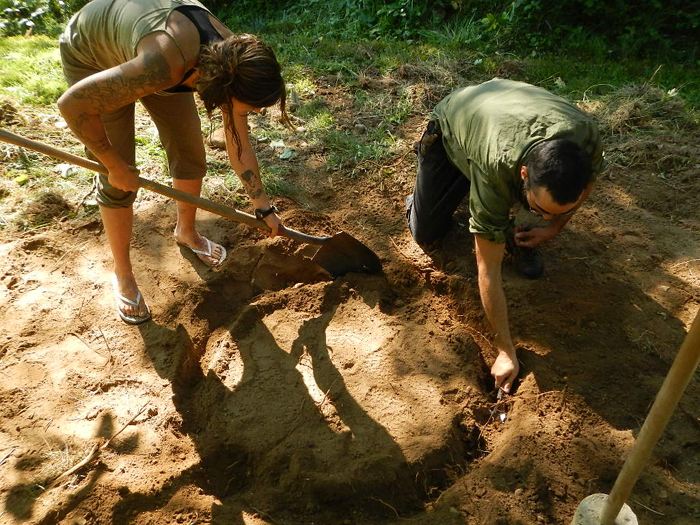
During our advanced fire making day, students worked with all natural materials harvested from the landscape to create bow-and-drill friction fire kits.  Here, student Christine digs for cedar rootlets, which can be used in place of cordage.

Here, student Coley demonstrates a bow with one of these cedar rootlet cords.

On another class day, students Christine, Elan, Riley, Beth, Alyssa, Austin and Rob test out a frame work they lashed together during their knots and lashings class.

Students Yusef, Caitlin and Jeremy work together to can applesauce during a permaculture class at Alderleaf.

Here is a look inside the pot during the process.  You can just see the lids of the jars being heated, in order to seal them.

Here is student Pete, happily displaying the bounty of a good canning session: spiced applesauce!

Keep an eye on our blog for more updates to come very soon!


November 1, 2012

Olympic Peninsula Field Trip

Last week students in the Alderleaf Wilderness Certification Program traveled west to the Olympic Peninsula.  Our first stop was the Makah museum on Neah Bay.  


On display were artifacts from a village that was buried in a mudslide some 500 years before.  We saw instruments used in whale hunting, cedar boxes and clothing, a reconstructed long house, and ceremonial objects. 


Next we were off to Lake Ozette to explore the coast and see where the village of Ozette once stoodIn order to get to the coast we hiked through the forest and learned about the plants, trees and mushrooms growing there.

On the coast the students climbed sea stacks.  Sea stacks are vertical rock formations standing in the sea that were formed entirely by wind and water. The formation process usually begins when the sea creates cracks in the headland, causing them to later collapse, and forming free-standing stacks.


Nereocystis, bull whip kelp, was found all along the shore.  All seaweeds are edible and excellent source of minerals, especially potassium, sodium, calcium, magnesium, nitrogen, iron, zinc, boron, copper, vanadium and nickel.

Instructor apprentice, Jeremy, found bear and cougar tracks on the beach!


 Makah petroglyphs etched into the Wedding Rocks, a cluster of shore-hugging boulders.


In the morning we were back in the vans and headed south to the Hoh Rainforest, where we learned about old growth forests and animals who live there.


The park is home to the largest unmanaged herd of Roosevelt elk, Cervus elaphus roosevelti, in the Pacific Northwest.


Roosevelt elk feed mainly on ferns, shrubs, and lichens from the rain forest, as well as meadow grasses. 


Pileated Woodpeckers are often associated with mature and old-growth forests.  They need standing dead wood for nesting and as a food source.  Pileated woodpeckers eat wood-boring insects and insects that nest in trees, including long-horned beetles and especially carpenter ants.


Picea sitchensis, Sitka spruce, dominate the park.  They reach heights of 80 meters with a trunk diameter of 5m and can live for over 700 years.


Another amazing field trip with Alderleaf, thank you to the trees, plants, the waters and our students...


October 19, 2012

Survival Priorities: WATER

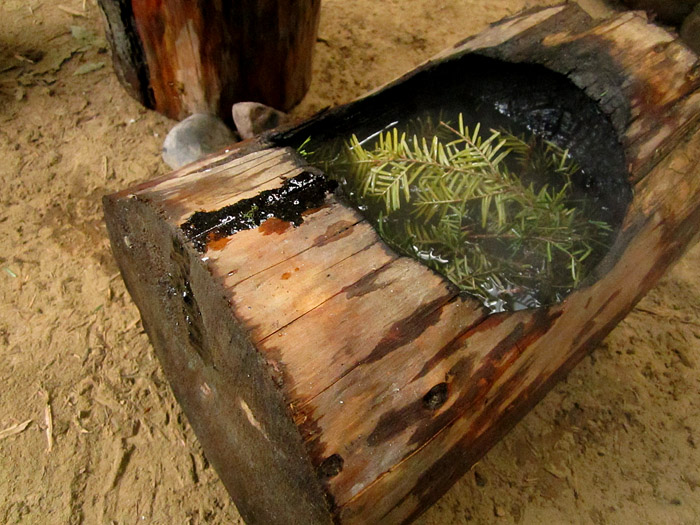
Water is one of the key survival priorities, and it is vital to make sure your water is safe to drink.  One of the oldest methods for water purification is boiling.  This week (October 17th) students in the Alderleaf Wilderness Certification Program got to practice using a primitive water boiling technique that involves a coal-burned wooden container.  First, they worked on making these containers - often called coal-burned bowls - so that they could purify water from a local stream.

Students Kristian and Bethany utilize their breath to encourage hot coals to burn down into the top of a log round.

Here Scott, Kristian and Bethany utilize the hollowed out stems of horsetail to focus air down on to the hot coals.

Once the burning process is completed, water is added and glowing red-hot rocks are place in it after being cleaned off to get rid of the ash.  Within a short time the water will start to boil and steam dramatically.  This is a very satisfying part of the day, as you can see by the faces of students Nick, Allan, Ethan and Austin.

Once the water is finished boiling, the rocks are removed and the leaves of western hemlock (Tsuga heterophylla)  are added for flavor.  Students Joanna, Bethany, Alyssa and instructor Michelle look forward to drinking this primitive wild tea.


When one of the water containers sprung a leak, students Christine and Torin utilized a creative approach to the problem by using a form of natural epoxy: pitch mixed with charcoal.  This simple solution kept their water in and allowed them to enjoy their success in the form of vitamin C-rich tea.


Keep an eye out for more updates soon from Alderleaf!


September 20, 2012

Shelter and Fire

The first few weeks of the Alderleaf Wilderness Certification Program have passed.  Students got to learn, practice and challenge themselves with a variety of important skills.  They got to sample fall wild edibles in the ethnobotany class, learned how to identify tracks in the wildlife tracking class and spent a week in the Oregon dunes practicing tracking and trailing skills.

They also learned how to take care of the essentials of survival, which includes shelter building and making fire from friction.

Here students Coley, Ethan and Riley add dry, fluffy debris to the inside of the shelter for bedding.  Other students worked on the outside, adding sticks as "ribs" and then covering the shelter in several feet of debris for insulation.

As the shelter went up, it was important to check it from the inside out to make sure no spots were missed and no holes left to let in the cold air or the rain.  Here Riley crawls in to have a look and let the others know where to put the materials for the greatest effect.


Here student, Austin, carves a new spindle for his bow-and-drill friction fire kit.  A spot of autumn sun shines on him as he works.

Alderleaf instructor Michelle teaches student Joanna how to make a bowline knot, to help secure the cord onto the bow.  It is key to have it properly attached, so that the spindle can spin quickly and consistently.


Austin puts all the parts of his kit together, gets into the proper form and spins the spindle until it makes a coal. Other students around him continue to work on their first bow-and-drill kits.

It takes some serious carving, sweat and patience to get your first friction fire.  Fire is one of the most important survival tools, it can purify our water, cook our food, and get us dry and warm after being soaked by the winter rains.  Fire is at the center of so many tasks in the wilderness, and through it we reconnect with all of our ancestors, who all once depended so much on fire to keep them alive, warm and fed.

Watch for more to come soon from Alderleaf!


Welcome AWCP Class of 2012-2013!

Another school year is now underway and the nine month Alderleaf Wilderness Certification Program (AWCP) is off to an fresh start.  This year Alderleaf has two cohorts of Certification Program students.

We are pleased to welcome all the wonderful new students of cohort 1...


 And cohort 2!


We are excited to get to know all of these enthusiastic, focused and passionate new students.  It will be an amazing journey helping them learn more about the natural world around them and their relationship to it.  The energy they bring to the class is palpable and there is no doubt this will be an amazing and unique school year.

More updates to come soon!

September 14, 2012

Bioblitz

During the end of the August, instructor Filip Tkaczyk and Alderleaf Wilderness Certification Program (AWCP) graduate Alexandra Vita and one of this year's AWCP students, Elan Rueven, participated in a local BioBlitz event.


The BioBlitz is an intensive scientific event in which experienced naturalists spend one or more days surveying for as many species as possible on a particular area of land.  This Bioblitz event took place on the Upper Skagit Indian Tribe's land at Hansen Creek.

The skills of wildlife tracking are a vital tool in surveying for what species can be found at a location, and which areas they tend to use frequently.  Determining what species are present can have great impact on how a parcel of land is conserved and managed into the future.  BioBlitz events also help reveal the diversity that is present at a site, and can help better to observe how changes in that landscape over time can effect the species found there.

There were many interesting finds during the survey, and even some surprises.

Here is one of the most common finds along the creek: the scat of a muskrat (Ondatra zibithicus).

The wetland areas were home to a variety of amphibian species, and many were seen even though it was late summer.  Here is a juvenile Northwestern salamander (Ambystoma gracile) which was found surprisingly in a parched area, that was once a wide pond.
Another surprise were these claw marks on an alder tree left behind by a black bear (Ursus americanus) that had climbed the tree in spring to feed on the catkins.

It was amazing day of discovery and science in action!  We look forward to more opportunities to participate in local BioBlitz events in the future.  Thank you to the Upper Skagit Indian Tribe for inviting us!


Cob Oven Building

Many hands made light work during the second weekend in August, when we constructed an awesome outdoor cob oven next to the main classroom space.  Here are some photos to showing the process from start, to near completion.


This is the tamping of the soil and establishing a foundation.

Once the foundation was established, a wire mesh skeletal frame was erected, and then filled over half full of stones.
Next, a layer of straw is add, with cob on top.  Inverted wine bottles are inserted into this layer.
On top of the bottle went another layer of cob, to seal them in.
Then, fire brick were put in forming a layer on top of the cob.  Onto the bricks was formed a gently sloping cone of moist sand.
The sand was then cover with moist newspaper, and cob was then layered on top of this mound.  Also, 4 bricks were especially cut to form the opening of the oven.
Cob is a hands-on method for building lasting and sustainable structures.  Thank you to all the hands that help build this lovely oven: Vita, Jeremy, Steve, Jason, Ted, Kerry, Haley, Jay and Kaia.  Also, a very special thanks to Eli Adadow for sharing his rich natural building knowledge and making this project possible!


July 31, 2012

Navigation and Nature Awareness Classes

This weekend, many local people joined us for 2 very different days of exciting classes. 

Saturday was spent learning and practicing a variety of different orienteering and navigation skills.  This included using map and compass as well as several forms of aidless navigation.  These students spent half of the day wandering around a local park practicing their skills in navigation and orienteering.

Sunday, in contrast, was focused on learning to understand, become more aware of and blend with the natural surroundings through the study of survival nature awareness skills.  This included interpreting the calls of birds, recognizing animal tracks, moving quietly and disappearing into the landscape.


Students practice moving quietly by playing a stalking game.

Its hard not to smile when you are reconnecting to the natural world through your senses!

Practicing hiding in plane sight, students blend into the background using a combination of camouflage and properly using available cover.

A special thank you to all of the enthusiastic students who joined us for the weekend classes!  We hope to see them return for more courses soon.

Keep an eye on our blog for more updates soon.