September 14, 2012

Bioblitz

During the end of the August, instructor Filip Tkaczyk and Alderleaf Wilderness Certification Program (AWCP) graduate Alexandra Vita and one of this year's AWCP students, Elan Rueven, participated in a local BioBlitz event.


The BioBlitz is an intensive scientific event in which experienced naturalists spend one or more days surveying for as many species as possible on a particular area of land.  This Bioblitz event took place on the Upper Skagit Indian Tribe's land at Hansen Creek.

The skills of wildlife tracking are a vital tool in surveying for what species can be found at a location, and which areas they tend to use frequently.  Determining what species are present can have great impact on how a parcel of land is conserved and managed into the future.  BioBlitz events also help reveal the diversity that is present at a site, and can help better to observe how changes in that landscape over time can effect the species found there.

There were many interesting finds during the survey, and even some surprises.

Here is one of the most common finds along the creek: the scat of a muskrat (Ondatra zibithicus).

The wetland areas were home to a variety of amphibian species, and many were seen even though it was late summer.  Here is a juvenile Northwestern salamander (Ambystoma gracile) which was found surprisingly in a parched area, that was once a wide pond.
Another surprise were these claw marks on an alder tree left behind by a black bear (Ursus americanus) that had climbed the tree in spring to feed on the catkins.

It was amazing day of discovery and science in action!  We look forward to more opportunities to participate in local BioBlitz events in the future.  Thank you to the Upper Skagit Indian Tribe for inviting us!


Cob Oven Building

Many hands made light work during the second weekend in August, when we constructed an awesome outdoor cob oven next to the main classroom space.  Here are some photos to showing the process from start, to near completion.


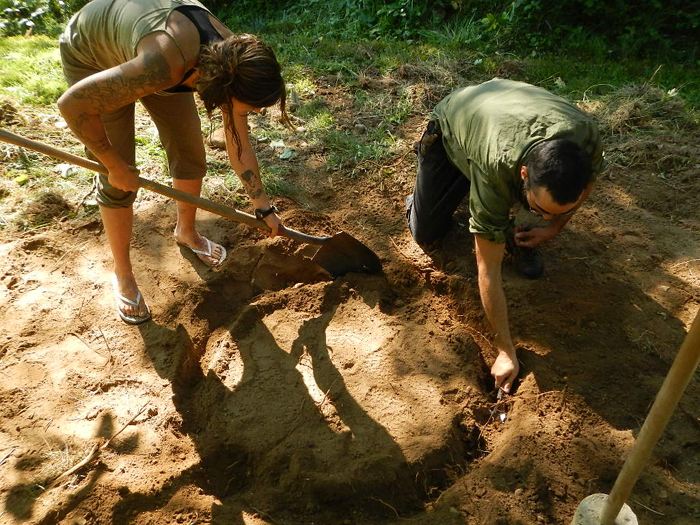
This is the tamping of the soil and establishing a foundation.

Once the foundation was established, a wire mesh skeletal frame was erected, and then filled over half full of stones.
Next, a layer of straw is add, with cob on top.  Inverted wine bottles are inserted into this layer.
On top of the bottle went another layer of cob, to seal them in.
Then, fire brick were put in forming a layer on top of the cob.  Onto the bricks was formed a gently sloping cone of moist sand.
The sand was then cover with moist newspaper, and cob was then layered on top of this mound.  Also, 4 bricks were especially cut to form the opening of the oven.
Cob is a hands-on method for building lasting and sustainable structures.  Thank you to all the hands that help build this lovely oven: Vita, Jeremy, Steve, Jason, Ted, Kerry, Haley, Jay and Kaia.  Also, a very special thanks to Eli Adadow for sharing his rich natural building knowledge and making this project possible!


July 31, 2012

Navigation and Nature Awareness Classes

This weekend, many local people joined us for 2 very different days of exciting classes. 

Saturday was spent learning and practicing a variety of different orienteering and navigation skills.  This included using map and compass as well as several forms of aidless navigation.  These students spent half of the day wandering around a local park practicing their skills in navigation and orienteering.

Sunday, in contrast, was focused on learning to understand, become more aware of and blend with the natural surroundings through the study of survival nature awareness skills.  This included interpreting the calls of birds, recognizing animal tracks, moving quietly and disappearing into the landscape.


Students practice moving quietly by playing a stalking game.

Its hard not to smile when you are reconnecting to the natural world through your senses!

Practicing hiding in plane sight, students blend into the background using a combination of camouflage and properly using available cover.

A special thank you to all of the enthusiastic students who joined us for the weekend classes!  We hope to see them return for more courses soon.

Keep an eye on our blog for more updates soon.


July 19, 2012

Photos of some of our Permaculture Projects and more

Central veggie garden - crop rotation system

Chicken "moat" around the central gardens to help with slug/bug control and many other stacked functions

Steve adding to the compost system

McCoy Creek with a hedge nettle flower in the foreground

Aquaculture pond with aquatic edible plants and bluegill fish

entryway sign

Food forest coming along

garden beds, compost system, and rainwater catchment off the chicken coop

Small greenhouse for veggie starts

Habitat restoration project by the entry sign

Harvesting strawberries from the hugelkultur bed

Inside view of the outdoor classroom

Outdoor classroom with salmonberry in foreground

Rainwater catchment on chicken coop

Root cellar almost completed

New woodshed also built from locust and cedar shakes
Learn more about our permaculture plan on our campus webpage: http://www.wildernesscollege.com/alderleaf-campus-and-facilities.html

Check out the upcoming Permaculture Design Course at Alderleaf: http://www.wildernesscollege.com/permaculture-summer-semester.html

July 18, 2012

Wilderness Survival Intensive

Last week, students joined us for 5 days of intensive wilderness survival training and learning.  The 5 days included the skills of shelter building, primitive cooking, primitive hunting and trapping, stone tools, bird language, primitive cooking and much more.

Students work together to seal a trout in clay in preparation for cooking on the coals.  Their hands tell the story.

Here students Eric and Mary Lee work together to burn out a wooden bowl.  Next, it will be used to purify water for drinking.  They use straws made of horsetail, a common wetland plant at Alderleaf.

Here you can see what the process looks like within the bowl.  As air is blow on the coals, the spread and burn, and eat their way down through the wood.  The trick is to control them to move in such a way as to create a nice bowl, and not burn through the side of this stump.

We look forward to seeing the survival intensive students return for more classes in the future.

Watch for more updates from Alderleaf soon!

July 3, 2012

Alderleaf Summer Courses

Now that our amazing Alderleaf Wilderness Certification Program has come to a close and we look forward to starting another year school in the fall, it might seem that things have slowed down here at Alderleaf.  This is not so, however, as we continue to teach a variety of short courses throughout the summertime.

We are excited about next week's Wilderness Survival Skills Intensive.  This 5 day course is an excellent introduction to many of the core skills of wilderness survival, including primitive fire skills, shelter building, wildlife tracking, stone tools, nature awareness and much more.  Check out more details and register here: http://www.wildernesscollege.com/wilderness-survival-skills.html

This course was included in an article in the Everett Herald last summer: http://www.heraldnet.com/article/20110910/NEWS01/709109937

Alderleaf Campus itself is showing the abundance of summer, with a variety of wild berries coming into season including salmonberry, thimbleberry, black-cap raspberry and others.  The rich mixture of greens are at there most impressive now.  The foliage houses many nesting birds. They can be seen busily flying to and fro, seeking insects and berries to stuff into the mouths of their eager chicks.

The ponds are rippling with all kinds of life-forms, including the tadpoles of several amphibians, colorful fish and a diversity of invertebrate creatures.


Summer is one of the most beautiful times of the year to visit and take classes at Alderleaf.  Come check us out and join us for some courses!


June 12, 2012

Progress Continues on Tracks & Sign of Reptiles and Amphibians

Our progress continues on the new tracking book, Tracks & Sign of Reptiles and Amphibians. Alderleaf instructors Jason Knight and myself (Filip Tkaczyk) continue to travel throughout the country gathering data on reptiles and amphibians.

The last 2 trips I took for the book included a trip to California and a trip throughout the Southwest (which included the states of NV, AZ, UT and NM). The trip before that was a trip to Florida.

Our knowledge base continues to grow and we look forward to the completion of this project. Here are some highlights from the 2 recent trips.

A Desert Banded Gecko (Coleonyx variegatus) from the Mojave desert in California.


And here are the tracks of the same gecko species.


A very large red diamond rattlesnake (Crotalus ruber) from coastal southern California.


Here is a sand-adapted lizard species called the Mojave Fringe-toed lizard (Uma scoparia).


And here is a hind foot from a fringe-toed lizard.  Notice the enlarged scales on the toes that act like "snow shoes" for running on loose sand.


Here is a spikey-looking Blainville's horned lizard (Phrynosoma blainvillii).


Here are a few highlights from the research trip to Florida.

A young eastern coachwhip (Masticophis flagellum flagellum).  The large eyes demonstrate the dominant sense of this active hunter.


This is a beautiful and harmless scarlet kingsnake (Lampropeltis elapsoides), which displays an excellent color mimicry of the highly venomous eastern coral snake (Micrurus fulvius fulvius).


Here are the fragmented remains of an American alligator (Alligator mississippiensis).  These are the parts of the skull, lower mandible, and skin.


Look for more updates from the Alderleaf Blog soon!


May 29, 2012

Slideshow of the 2011-2012 Wilderness Certification Program!


The Alderleaf Wilderness Certification Program just held its annual graduation ceremony on May 26, 2012. It was an amazing year filled with much learning, adventure, and accomplishment. Check out photos from their program in this video slideshow. Congratulations again to all of the graduates!

April 13, 2012

Spring Activities at Alderleaf

The past few weeks have been very busy and exciting for the Alderleaf Wilderness Certification Program students. Here are some recent highlights from different class days...


Here one of the students practiced the skill of making baskets out of pine needles. Each student had their own particular approach, so the baskets were completed in a variety of shapes and sizes.


Here are just a few examples of completed baskets.

On another class day, students learned more about Permaculture practices. Students got out on the farm to enjoy the sun and apply some of what they have learned.


Here Certification Program students Shaun and Jared work together to help create plant cuttings for raspberry plants, so that more plants can be grown and spread around the farm.


Spring is showing its lovely face everywhere you look around at Alderleaf. Flowers are bursting, frogs are chorusing and the sun is shinning!


Yesterday, students worked on trying out several primitive cooking methods which included steam pit cooking, clay baking on coals and cooking in a clay oven. Some students also created utensils to eat their cooked food with.


Here student Gianna blows on a coal to encourage it to burn out a cavity for her wooden spoon.


Student Carrie carefully seals the clay on the outside of a trout, that will soon be laid into the hot coals of the fire. This form of primitive cooking cooks food very evenly, and seals in the moisture. The trout came out cooked to perfection!


Here student Alex closes the door to the clay oven, to help trap in the heat in preparation for some primitive baking.

The students had an excellent time learning how to use these different methods of cooking and at the end of the day, they got to enjoy the fruits of their labor by having a primitively cooked feast! The food was delicious, included a variety of vegatables, salmon and some cornish game hens. and did not even require any spices, as it was cooked to perfection.

Next week the students are heading out into the field to take their Track & Sign Evaluations. Wish them luck!